Xbox, Game-pass and Aggregators and free to play games.
Xbox has had messy restructuring recently, and it is sort of the end of the Game Pass era.
Xbox has had messy restructuring recently, and it is sort of the end of the Game Pass era.
The business model on paper made sense; if anything, it is the ideal model on paper: games should be bundled rather than bought for 60 bucks a pop. But video games are inherently not ephemeral, and the desire is not really the content. It is really more about the social interactions and the desire to experience what one believes they never could in reality.
This is compounded by the gains made in free-to-play gaming. This is the ideal business model in general. Virtual goods have effectively no COGS and have pricing power. This leads to another problem with Game Pass being that an aggregator already exists in gaming, which is Steam. Steam used the great form factor of the internet to disrupt the traditional distribution model and allowed game developers to go direct to consumers.
This essentially created reinforcing network effects for Steam and created the gaming store for the internet. So, in an industry where PC is the dominant platform. And F2P games dominate the vast majority of gamers, what role does Microsoft play? Sony, on the other hand, has focused on creating exclusive games such as Spider-Man. This creates a real reason for a gamer to buy the Playstation, for the game. Now, arguably, Xbox should have just done the same and focused on first-party exclusives. Instead, they tried to build a aggregator, but the problem being is that developers and console makers are all incentivized to sell expensive games individually.
So Microsoft decided to acquire game studios, most notably Activision Blizzard. But the problem again is that games do not have the same dynamic as Netflix and movies and TV shows. Much rather, most games around 60% only buy a couple games a year, so Game Pass is not really worth it. And the hardcore gamers, which are a much smaller subset of the market, will probably make up a large part of the 30m subscribers. Although Microsoft has a history of overstating numbers, so perhaps even that is exaggerated. The thing with subscription business models is that you want as many customers as possible to amortize the cost; in Microsoft's case, a very expensive cost around 80 billion in total game studios. So by creating a product only a subset of the market would use, they set themselves up for failure.
Overall it has been a struggle, and the recent layoffs do not really help. That raises the question why in the world even keep pursuing this. Because Xbox was started to keep Windows from becoming irrelvant as a distribution stratgey. Now Windows is not the core business at all, keeping Xbox seems dumb. But they have a huge sunk cost fallacy with all the studios they have acquired, so a spin off or selling the entire business largely would not command the premium that the IP they own really deserves. So likely they will focus on creating Xbox exclusives to increase sales, and also keep Game Pass going anyway, considering it’s on a 5 billion run rate. Regardless, Microsoft’s acquisition of Activision Blizzard will go down as an example of poor capital allocation and poorer strategy. Some rough math, assuming a 30% margin on Game Pass, they have likely made around 20 billion since the inception in 2017. That is 6 billion in profit, and user growth has already stalled. So the path ahead is financially daunting.
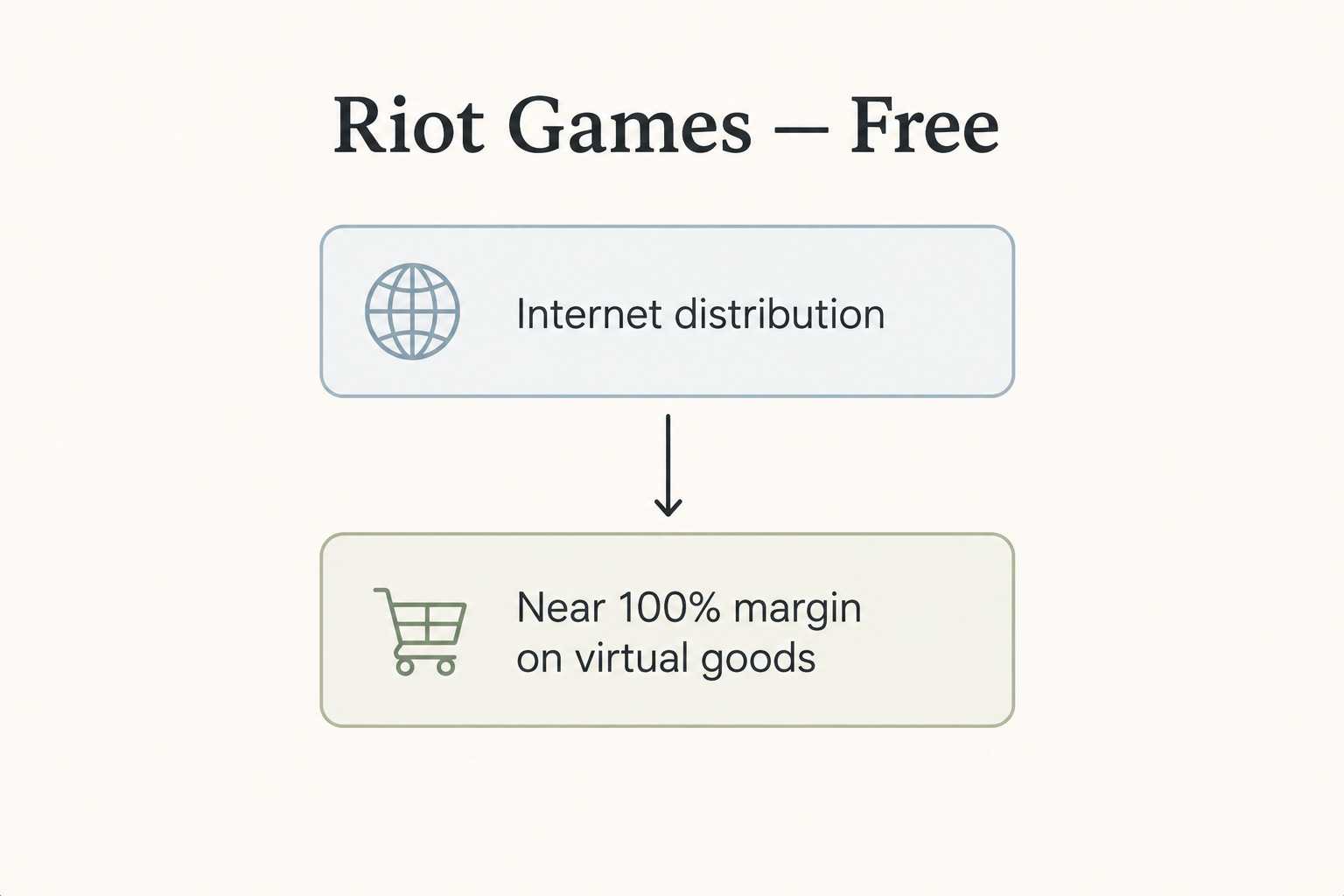
A Strategy that has worked is Riot Games and League of Legends, which intentionally started the studio from the perspective of the free-to-play business model, combined with the internet for distribution and the virtual goods model, has made League of Legends one of the highest-grossing games ever. It is an example of what an internet-enabled business really allows. So with declining Xbox sales, Microsoft's gaming division is really a game studio, and to compete with Tencent, they will have to release free-to-play games.
Links -
https://www.videogameschronicle.com/news/more-than-60-of-us-game-players-only-buy-two-games-or-fewer-per-year-survey-finds/
https://abovethecrowd.com/2009/03/09/how-to-monetize-a-social-network-myspace-and-facebook-should-follow-tencent/
Originally published on Tech&Media / Substack ↗