Uber, disruption and AV's.
There is a major debate around Uber as of late, on one hand from many valuation perspectives that it is undervalued, and the bear case being this is for good reason, centrally that in a world of AV’s you need to be vertically integrated.
There is a major debate around Uber as of late, on one hand from many valuation perspectives that it is undervalued, and the bear case being this is for good reason, centrally that in a world of AV’s you need to be vertically integrated.
Uber Today
First, it is important to understand why Uber has worked. Mobile has allowed the wave of apps such as Uber to thrive. When you think of ridesharing in a vacuum, Uber and Lyft do not have differentiation among each other; yeah, the boom of the ZIRP period led to capital as a weapon in startups, and to an extent, simplistically, Uber spent more than Lyft on CAC on both sides, and simply edged out Lyft. After that, a great CEO, Dara Khosrowshahi, has created a brilliant strategy for Uber today.
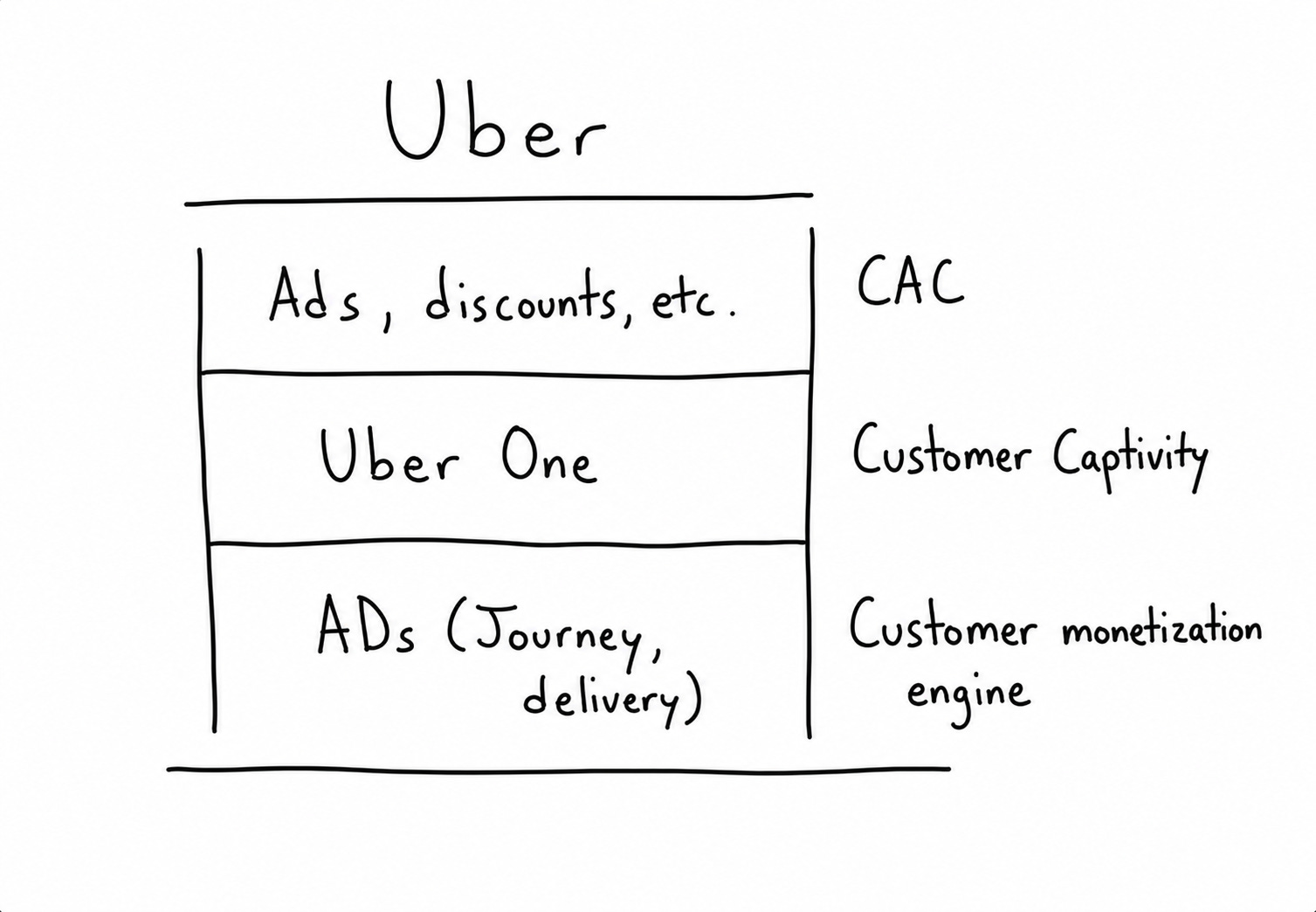
Uber spends the most to acquire customers and drivers, uses Uber One to create customer loyalty, and monetizes through ads. It is truly a brilliant strategy funnel, built on the aggregation of ridesharing and delivery customers and drivers.
Waymo and the disruption oppurtunity
The market thinks vertical integration will kill Uber. How so, well Waymo does not need to aggregate drivers since they own the supply of vehicles, this a capital intensive business from the get go. For Waymo to disrupt Uber they would need to create their own DTC model and bring enough network liquidity everywhere so that people choose it over to Uber. Considering Uber has a decade headstart on the job, currently Waymo is on Uber itself and so will many other AV companies, with a plethora of funding in the space it does seem Uber is positioned to become a aggregator of all ridesharing, while this may mean they stop taking margin on the rides they serve themsevles and just become a platform for the AV companies, considering the original ridesharing business with drivers will decline over time, as AV options will be a fraction of the cost. If anything this is much more of a disruption problem for car manufacturers, while they surley are not going extinct, the profit margin will continue to shrink, as a few firms eg. Waymo will buy cars shifting the leverage in their favor.
I think Waymo can attempt to build it’s own customer relationship, but they would be foolish to not be on Uber, because if they do not there competition will, hence forcing Waymo to stay on Uber. Regardless the AV layer seems to have the makings of a commodity business, and Uber the middlemen should capture the majority value, and see growth in the business. So it was the correct strategic decison to exit that business considering the capital intensivity, which would lower margins, and the fact there is no clear differentiation or barrier. Here are some numbers on how their topline can grow. The key metric to watch here is how much GBV grows based on the potential the AV ridesharing market posses, since based on that we can assume what % of revenue is ads, and predict growth in the ads business considering it is what drives fcf growth.
The AV ridesharing market is expected to grow between 70 - 100% CAGR through the early 2030s, somewhere between a 150 - 200 billion market. Clearly a oppurtunity for Uber to continue to expand growth and embrace the aggreagtor role. While as a platform with large companies such as Waymo, they will be forced to lower their effective take rate, further showcasing the key monetization engine of ads on top of the actual business.
Originally published on Tech&Media / Substack ↗