Nintendo the Media Company?
Nintendo today is a quasi-diversified media company.
Nintendo today is a quasi-diversified media company. At least that is what the future of this company appears to be. Nintendo has a rich and fun history, and if you want to know about it, go listen to AcquiredFM's two-part series on it. Nintendo’s stock has been another story. Many 80% drawdowns through bad periods in the business, such as after the iPhone launch, and when it became clear that was the dominant platform for casual gaming. Or after the Wii U was launched and sales were a shell of the Wii. These events should have put Nintendo out the hardware business, and have had a SEGA-like ending. Yet their Japanese values have kept them resilient and now in a position better than ever. The power of compounding their IP through many generations has been very crucial to the future of their business. They own some of the greatest and most timeless IP ever: Pokémon, Mario, Donkey Kong, Zelda, just to name a few.
Much discussion has been about how they have under-monetized their IP and not gone into the mobile gaming business. Or the free-to-play model, and their stubbornness to stick to the console + high-margin software business. Yet the Switch 1 and 2, the best-selling console ever, and the 2 on the same path, have proved that Nintendo has built a console platform with its own rich first-party IP, plus a third-party developer ecosystem, which can now rely on Nintendo consistently for indie and middle-market games. So Nintendo is likely in the most steady state it has ever been. What’s the future, and can there be real shareholder value created?
So why is Nintendo being discounted in the public markets? Currently, they have a pe ratio of 19, and a price-to-sales ratio of around 3. Firstly, having their parent company based out of Japan gives them several protections from shareholder activism. Shareholders inherently have less control, and many activist campaigns in the past have failed. Potential sales also are not realistic to foreign companies since the country of Japan would likely save Nintendo. So shareholder interests are not always a priority.
This allows Nintendo to not constantly profit maximize relative to the short term, such as Sony or Microsoft. Rather than having to put their games on mobile and dilute characters, they have been able to do so only limitedly. Another reason for the discount is the massive treasury they have of cash, end of FY26, they had 14 billion in cash and cash equivalents. They have been resistant to make acquisitions or share buybacks, which has frustrated Wall Street, in turn, hurt the stock. And revenue is cyclical and nearly doubled after the launch of the Switch 2 from 7 billion. These are the risks really holding Nintendo down.
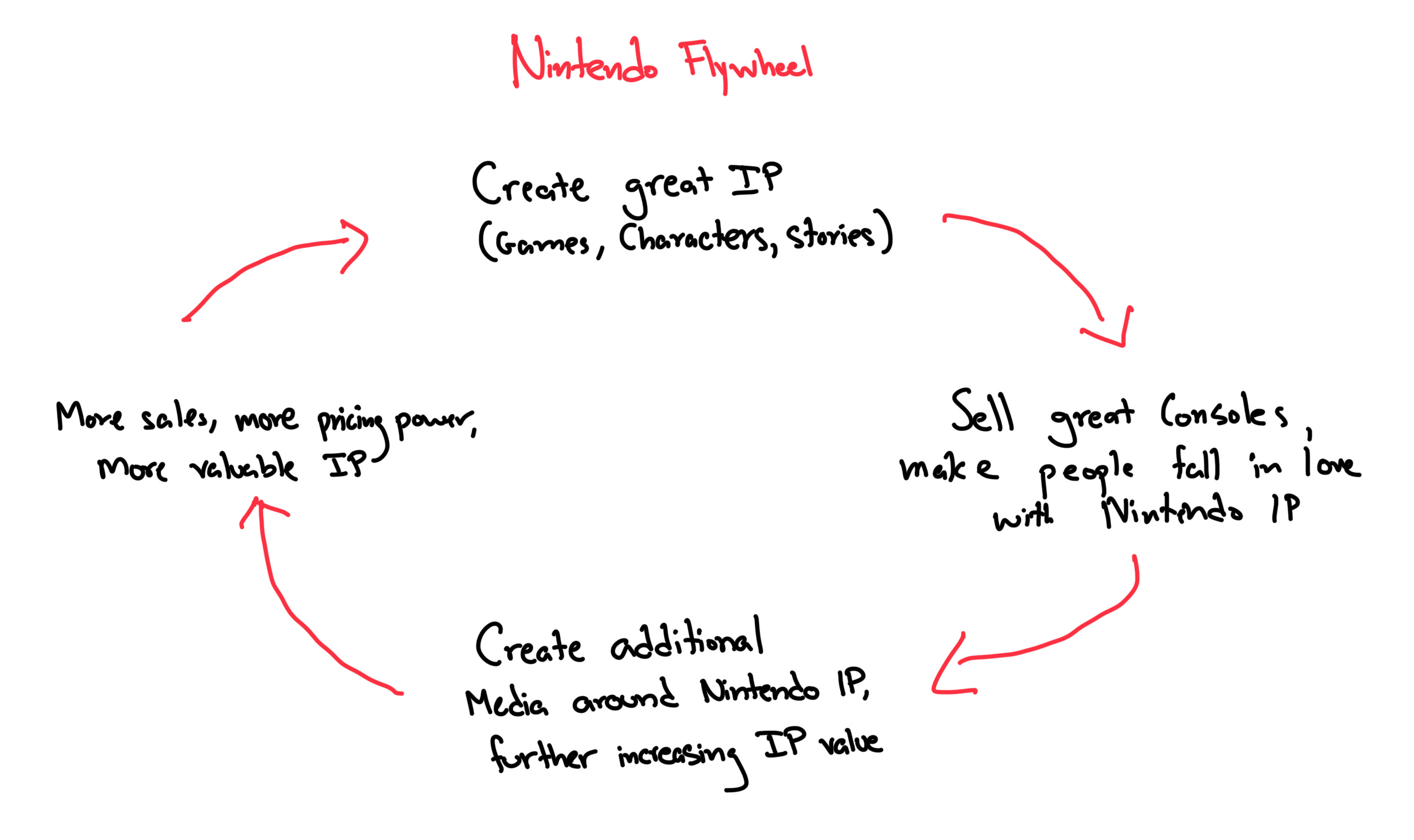
So Nintendo is transitioning to a full-fledged media company. IP is a cornered resource; that is the main power/moat Nintendo really has. Their ability to use their IP to create theme parks, movies, TV shows, and collectibles will define the future of their business. Similar to Disney, the core of the flywheel for Nintendo is making great games, something they have never wavered from. Building games and marketing them to consumers and creating a story has built this IP into one of the greatest collections ever. While the IP business is only 3%, the commercial success of the first two Mario movies- genuine billion-dollar blockbusters which have Nintendo to get a 50% cut, based on 50% of the financing. Plus the new Zelda movie in 2027, which will likely do the same, if not more. The theme park agreement with Universal, which will bring in consistent licensing fee streams and merchandise revenue splits. While there are no specific disclosures for licensing revenue, industry estimates are that Nintendo makes somewhere between 2 to 5% of Universal Studios' parks revenue. This tracks, considering the revenue growth driven by the Nintendo lands in Japan and the US. Roughly 300 million a year from parks, and this should grow as new parks such as Donkey Kong Land are made. Beyond that, collectible revenue such as from The Pokemon Company. Nintendo owns around 40%, there 1/3 stake in the JV and an indirect ownership through a 10% stake in Creatures Inc, a partner in the JV, should continue to grow as the IP becomes more valuable over time. Their recurring subscription business, Nintendo Online, which offers access to older games on the Switch, is already on a 1.2 billion run rate. This is largely nostalgia-fueled from the days of playing on the Game Boy and the NES emulators. So it’s expected this segment grows, and 1/3 of Switch users are subscribers.
By becoming a media company, Nintendo is able to rely less on the cyclicality of consoles, and focus on what they have done best for generations: make great games and characters, and stories. Margins should increase as most of their revenue should transition into high-margin media deals, Software games that are becoming increasingly digital, and Nintendo Online. Hence, decreasing the dependency on the new console generations. Creating the case for a long-term, consistent free cash flow juggernaut.
The closest comparable to this vision of Nintendo is Disney. Nintendo’s current market cap is 50 billion. Disney’s market cap is 160 billion, although on a much larger revenue base. Disney’s most profitable segment is its Parks & Entertainment. In the same way Nintendo’s core business is still making great games and secondarily making consoles, these endeavors have great fixed costs and booms and busts. By adding the media-enabled flywheel, Nintendo gains the trust of investors and can really unlock shareholder value.
Originally published on Tech&Media / Substack ↗